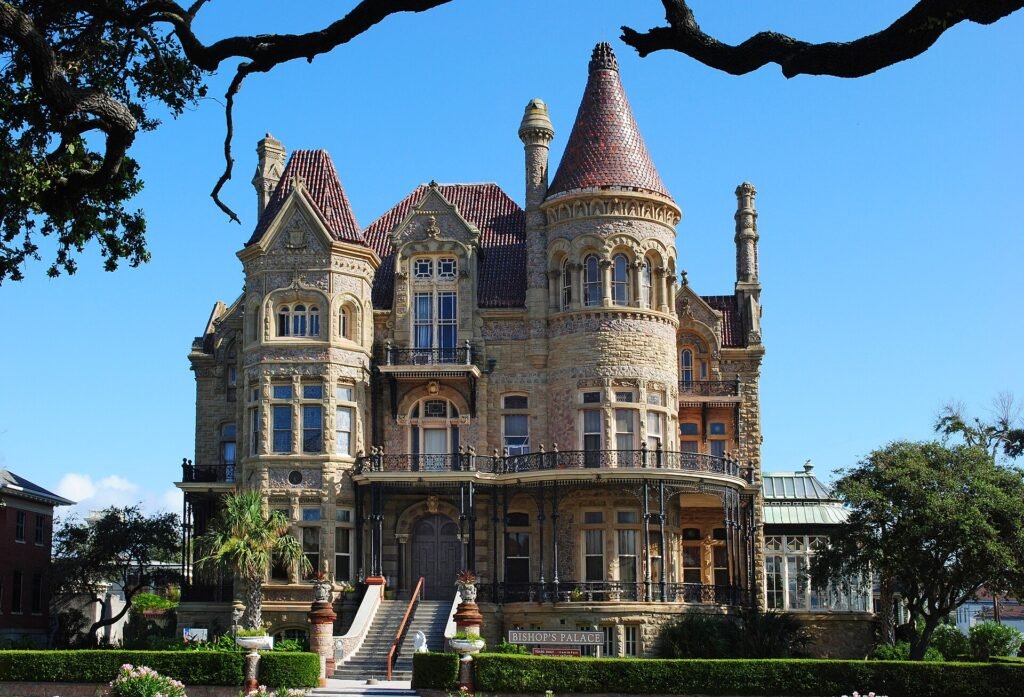
Cover: Bishop’s Palace exterior in Galveston (2011). Photo: Rwminix. CC BY-SA 3.0. Photo source · License
Bishop’s Palace in Galveston is a place to slow down and look at how a building is put together. You do not need architectural training to enjoy that process. Start with the details you can see, use the tour information to understand them, and leave room for questions that deserve more research.
The Galveston Historical Foundation’s official guide identifies the 1892 house at 1402 Broadway, also known as Gresham House. It is a historic site in the East End Historic District with self-guided visits and separately scheduled special tours. Check the current schedule and closure notices rather than assuming every part of the building is included in an ordinary ticket.
Choose the tour that matches your interest
A general visit and a special behind-the-scenes tour answer different questions. Read what the particular ticket includes before purchasing. If your main interest is architectural detail, you may prefer enough time to look carefully at the regular route rather than adding a more extensive tour to an already crowded day.
Know the architect, then choose the level of access
The Library of Congress Historic American Buildings Survey record identifies Nicholas Clayton as the architect of the Walter Gresham House, also known as Bishop’s Palace. Knowing the architect and the earlier name gives you useful search terms for research before or after the tour, and helps connect the building with documented architectural records rather than unsourced anecdotes.
The Galveston Historical Foundation distinguishes the regular self-guided experience from its separately scheduled Basement to Attic tours. The special offering includes areas beyond the ordinary route, such as Mrs. Gresham’s studio. Read the current description of the particular ticket before deciding whether the extra access matches your interest and physical needs.
A regular tour can still support a detailed architecture visit. Choose a subject you can follow through the permitted rooms, such as the relationship between a large decorative feature and the smaller details around it. Give yourself time to read the interpretation and ask a question instead of treating the route as a checklist of photographs.

Choose a few subjects to follow through the visit: materials, changes in scale, or the way one room connects with another. You can make that list without claiming to know the architect’s intention. Let the official interpretation supply the documented context.
Look for relationships, not just impressive details
A decorative element can be striking on its own, but its position may be just as interesting. Notice where your eye is directed when you enter a space and how a doorway frames the next view. Compare a close detail with the room around it.
Connect materials with the building’s documented story
The Texas Historical Commission marker record credits Mrs. Gresham with painted murals and ceilings and records the Catholic Diocese’s purchase in 1923. Those details point toward two useful subjects for the tour: the contribution of a household member to the interiors and the changes in use that help explain the building’s later identity.
Look for the distinction between a material and the way it is worked. Stone can form a large surface or a carved detail; wood can organize a room or draw attention to an opening. Use the tour’s descriptions to identify what you see rather than assigning a material from color alone. If a label introduces an unfamiliar term, write it down with the feature it describes.
After the visit, the Library of Congress record offers photographs, measured drawings, and written survey material. Comparing those resources with your notes can deepen the experience. Remember that archival documentation describes the building at the time of the record; it is not a report on current access, present condition, or everything included in today’s visitor route.

If photography is permitted during your visit, take a wide view and a detail view rather than collecting only close-ups. Record what the tour actually identifies and leave uncertain labels out of your caption. You can always look something up later instead of repeating a plausible but unverified story.
Ask about access before booking
The Foundation states that Bishop’s Palace is not fully accessible and does not have a wheelchair or walker ramp. It describes an alternative audio tour with photographs and a written transcript. Contact the operator before visiting if these arrangements or other physical-access details affect your plan.
Allow enough time to arrive and complete the permitted route without rushing. The official page distinguishes closing time from the last ticket sale and lists special closures. Confirm those details for your date, particularly when traveling from elsewhere in the Houston area.
Make the alternative interpretation part of the plan
The Foundation’s access information describes an audio tour with photographs and a written transcript as an alternative for visitors who cannot use the full physical route. Contact the site in advance to discuss how that option works and what arrangements are needed. Ask about the particular part of the experience that matters to you, rather than expecting an accommodation to operate in one assumed format.
For a group, agree on how everyone will participate before buying separate tickets. One person may want the architectural archive afterward, another the ordinary tour, and another an alternative format. A shared interest in the building does not require identical movement through it. Confirm the practical arrangements with the operator so nobody arrives expecting access that is unavailable.
If you add a look at the surrounding streets, keep it independent of the interior ticket and remain in permitted public areas. The historic district setting is interesting on its own, but other buildings may be private or have different visiting arrangements. End with one documented detail and one question you would like to explore further; that is a more useful memory than a collection of uncertain architectural labels.
Open an architecture observation prompt
Choose one material, one doorway, and one view through a room. Describe what you see before interpreting it. Use the tour to check names and dates. Respect barriers and photography rules. Save any unanswered question for further research.
Keep admiration and homeownership questions separate
An historic-house visit can sharpen your appreciation of craftsmanship without telling you what another older home will require. A beautiful detail is not evidence about concealed systems, previous alterations, maintenance needs, or permission for future work. Those questions belong to the specific property and its records.
Explore our Galveston local guide for more context around island neighborhoods and outings. If you are considering a purchase, the Aurhomes Group buyer guide can help organize the next steps. Bring the curiosity inspired by Bishop’s Palace, then evaluate each potential home with the care its own history and condition require.